Sega on AI EP1, Annotated: Is Taiwan an AI Superpower or an AI Foundry?
A conversation between iKala founder Sega Cheng and Dr. Lee-Feng Chien, former MD of Google Taiwan. From the Computex-fueled Capital Island phenomenon through whether AI is a bubble, the agent era as a hard requirement, a projected 24x jump in token consumption by 2030 and hardware optimization, US East vs West views, Taiwan's five shortages and internationalization by acquisition, luckily Taiwan's software was weak, Agentic Commerce and the Zero-Click economy with GEO, and R&D compressed from ten years to six months. Closes with the Ask / Use / Manage / Build framework for becoming the 1%.
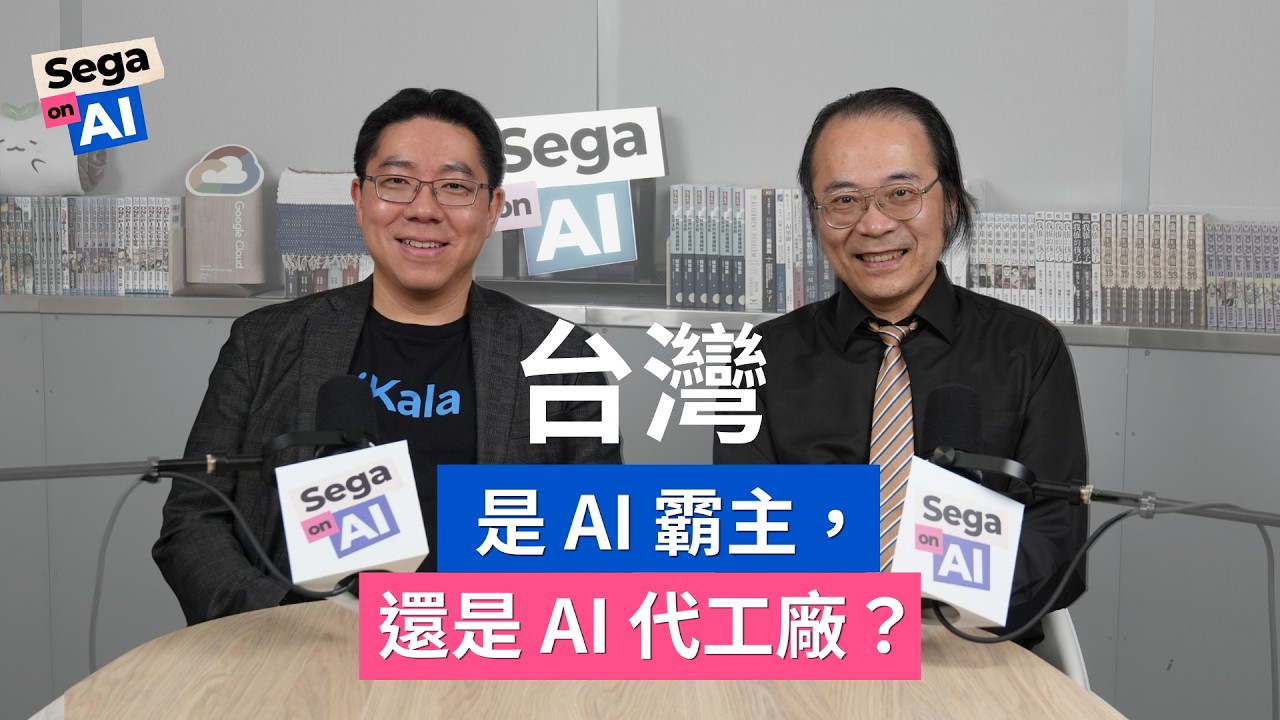
Original video: Sega on AI EP1, Is Taiwan an AI Superpower or an AI Foundry? (YouTube)
This is the first episode of Sega on AI, a new show hosted by iKala founder Sega Cheng, with guest Dr. Lee-Feng Chien, former Managing Director of Google Taiwan. It runs about 57 minutes and is sponsored by Google. The whole episode circles one question: in this wave of AI, is Taiwan a lead actor at center stage, or a supporting player doing someone else's manufacturing?
Note: this page is built from the official chapter outline and timestamps in the video description (the video ships no captions/CC, so a verbatim transcript was not available). What follows is the backbone of the argument, plus my own extended reading, not a line-by-line quotation.
1. From "pilgrimage to CES" to "Capital Island"
The conversation opens on a shift in the industry's center of gravity. Taiwan's tech scene used to fly to the US to pay its respects at CES; now the whole world flows into Taiwan for Computex. Dr. Chien calls it a "chemical change": Taiwan's stock market briefly approached Japan's in scale, becoming an unprecedented "Capital Island." This is not just share prices. It is global capital starting to treat Taiwan as the center of gravity of the AI supply chain.
2. Is AI a bubble? The agent era is a hard requirement
To the worry that AI is just another bubble, both men land on the same read: this wave is a hard requirement, not pure hype. The reason is the rise of the agent era. What companies want is no longer a chat toy but "AI employees" that actually get work done, especially standing in for high-value, repetitive knowledge work. When demand is backed by real productivity, it does not collapse out of thin air. (Related: the Rails homepage is now pitching to AI agents too, see rails-from-prompt-to-ipo.)
3. Tokens up 24x: hardware optimization is Taiwan's key play
If AI employees work at scale, the price is an explosion in token consumption. The episode cites a projected ~24x jump in token consumption by 2030. That loops straight back to Taiwan's strength: when compute demand grows exponentially, hardware and energy-efficiency optimization becomes the deciding move, and the reason Taiwan's "sacred mountain range" (not just TSMC, but the whole semiconductor cluster) keeps holding position. Saving tokens is not only a cloud problem; it happens at the programming-language layer too (see vibe-coding-token-efficiency-by-language).
4. US East vs West: the spear of policy, the shield of founders
Dr. Chien frames the tension inside the US as a contrast: the East Coast are the policymakers, worried about national security, public safety, geopolitics (the "spear"); the West Coast are the tech founders, chasing speed and breakthroughs (the "shield"). The collision of these two forces steers the whole global AI supply chain, and Taiwan sits right at the core of that chain, unable to stand apart from it.
5. Taiwan's "five shortages" and the internationalization fix
Taiwan's structural limits (the familiar "five shortages": water, power, land, labor, talent) are amplified in the AI era. Dr. Chien's fix: Taiwan cannot stay on the island. It has to widen the definition of "being Taiwanese" and use "smart money" for international acquisition of talent and technology, turning the Capital Island advantage into leverage for a global footprint.
6. "Luckily Taiwan's software was weak": a reshuffle is an opening
This is the most counterintuitive line of the episode. Dr. Chien argues that precisely because Taiwan's software industry was relatively weak, AI has drastically lowered the barrier to software development, which gives Taiwan a chance to reshuffle the deck. The key move: Taiwan's software should grow on top of its hardware (hardware-software integration), then use AI to add the ability to scale, rather than going head to head with the US on pure SaaS.
7. Where's the beef? Agentic Commerce and the Zero-Click economy
The business models shift just as sharply:
- Agentic Commerce: AI agents make repetitive purchases on your behalf, optimize enterprise ERP, and reduce inventory risk.
- Zero-Click economy: users stop clicking into page after page; the AI just gives the answer.
- GEO (Generative Engine Optimization): when the entry point moves from search engine to generative AI, the rules of traditional SEO and search advertising get rewritten, replaced by "how do I get the AI to cite or recommend me when it generates its answer."
8. The real value: R&D leverage, not operational cost-cutting
An important correction: AI's biggest value is not cost-cutting in operations (fewer people, lower costs), but leverage in core-product R&D. When an R&D cycle can shrink from ten years to six months, every industry hits a new economic rhythm. Whoever can pull R&D speed up gets to redefine the competition.
9. How to become the 1%: Ask, Use, Manage, Build
The episode closes with Dr. Chien's four-part framework for young people (and everyone in tech) to survive the AI current and even become the 1% who matter:
| Facet | Meaning |
|---|---|
| Ask | Ask the right questions. The ability to ask is where steering AI begins. |
| Use | Use AI tools fluently, turning them into everyday productivity. |
| Manage | Manage the AI and vouch for the results (human-in-the-loop). |
| Build | Build your own AI persona/application, moving from user to creator. |
He encourages everyone to build a personal "AI persona": in the AI era, anyone can be the boss and chase a big dream. This "Ask, Use, Manage, Build" path runs parallel to the plain-language route in "getting work done with AI even if you're not technical" (see using-ai-at-work-for-non-tech-people), and the "Manage" facet, daring to use AI and daring to vouch for it, echoes the idea that using AI takes courage and also takes stopping to check the work at the critical points.
10. Extended reading: three contrasts, and where they match how I think
The following is my own extended reading of the episode's three core contrasts. Because there is no transcript, these are synthesized viewpoints and insights (the episode's arguments combined with positions I hold consistently), not verbatim quotes. I will annotate the original lines once I add them.
Software vs internet: Taiwan should play "software," not "internet"
These two words often get lumped together, but their business logic is completely different:
- Internet (platform) runs on network effects and two-sided markets; it is winner-take-all by nature. Once Google, Meta, or Amazon lock in a position, latecomers have almost no room. Taiwan never won at this layer and probably never will, because the contest is not about technology but about first-mover lock-in and scale.
- Software is a tool and a system: you can sell it to enterprises, embed it into hardware, and go deep in a vertical. It does not need winner-take-all; doing one domain right is already valuable.
Key insight: AI pulls these two layers further apart. AI makes "writing software" far cheaper (software is no longer the moat), but the model-platform layer itself becomes a new battlefield of network effects and data flywheels, and that layer is again winner-take-all for the giants. So Taiwan's right answer is not to fight for the model platform (another internet war), but to return to the position of software embedded in hardware, going deep in verticals, treating AI as a tool rather than a moat. That is the real reason "luckily Taiwan's software was weak" can turn into an advantage: what was weak is the "internet platform" kind of software, not the "grown into hardware and the domain" kind.
(My own work runs on exactly this path: the medical system is "software × vertical domain," not a platform; one person plus AI puts it into production, see one-person-devops-talk.)
Old firms vs startups: the moat shifts from "can you write software" to "dare you rebuild with AI"
The internet era was startups crushing incumbents with network effects. But the AI era flips half of that equation:
- AI's biggest value is R&D leverage and grafting onto existing operations, and data, domain knowledge, channels, regulatory relationships, and capital are exactly the cards incumbents already hold. When AI knocks out the barrier of "building software," the old moat of pure-software startups gets knocked out with it.
- But "AI-native / agentic from day one" startups can still cut the corner in verticals that incumbents are too slow to turn toward.
Key insight: the dividing line is no longer "old vs new," but "dare you rebuild R&D and process with AI." Incumbents willing to compress the R&D cycle with AI and layer AI onto existing flows are the biggest beneficiaries; whoever clings to an old moat gets washed out, old or new. And when "one person plus AI" can carry what a whole team used to (see rails-from-prompt-to-ipo), the barrier to founding drops to near zero, and the real moat retreats to domain + data + the nerve to put a system into production.
Vertical integration: AI rewards the integrator of "software + hardware + domain"
Taiwan's semiconductor edge is, at its core, a vertically integrated supply chain (the whole sacred mountain range, not a single company). The AI era scales that logic up to the full stack:
- The ones capturing the most value are full-stack vertical integrators: NVIDIA (chips + CUDA + software ecosystem), Apple (in-house silicon + OS + apps). Pure hardware or pure horizontal software gets squeezed from both sides and sees its margins thinned.
- For Taiwan, this means integrating upward, growing from hardware into software, systems, and AI ("software grown on top of hardware" is itself a form of vertical integration), rather than fighting the US in the horizontal pure-software market.
Key insight: vertical integration is about efficiency, but do not lock yourself in. What I advocate is a kind of open vertical integration: use open standards (FHIR, REST) and modularity to get the efficiency of vertical integration while keeping the freedom to swap out one Lego brick at a time, never captured by a single vendor (see digital-transformation-evangelist-en). The depth of vertical integration, plus the freedom of open standards, is what lets a small team carry a large platform.
One-line summary
Taiwan's answer is not a binary of "superpower or foundry." Dr. Chien's case: hold the core of the supply chain with hardware and energy-efficiency optimization (the sacred mountain range), patch the "five shortages" through international acquisition, and seize the reshuffle moment as AI lowers the software barrier by growing software on top of hardware. Taiwan can upgrade from "foundry" to "one of the lead actors." For the individual, whether you get a seat at the table comes down to whether you can Ask, Use, Manage, and Build.