The Digital-Transformation Evangelist: Making a Hospital's IT Quietly Better
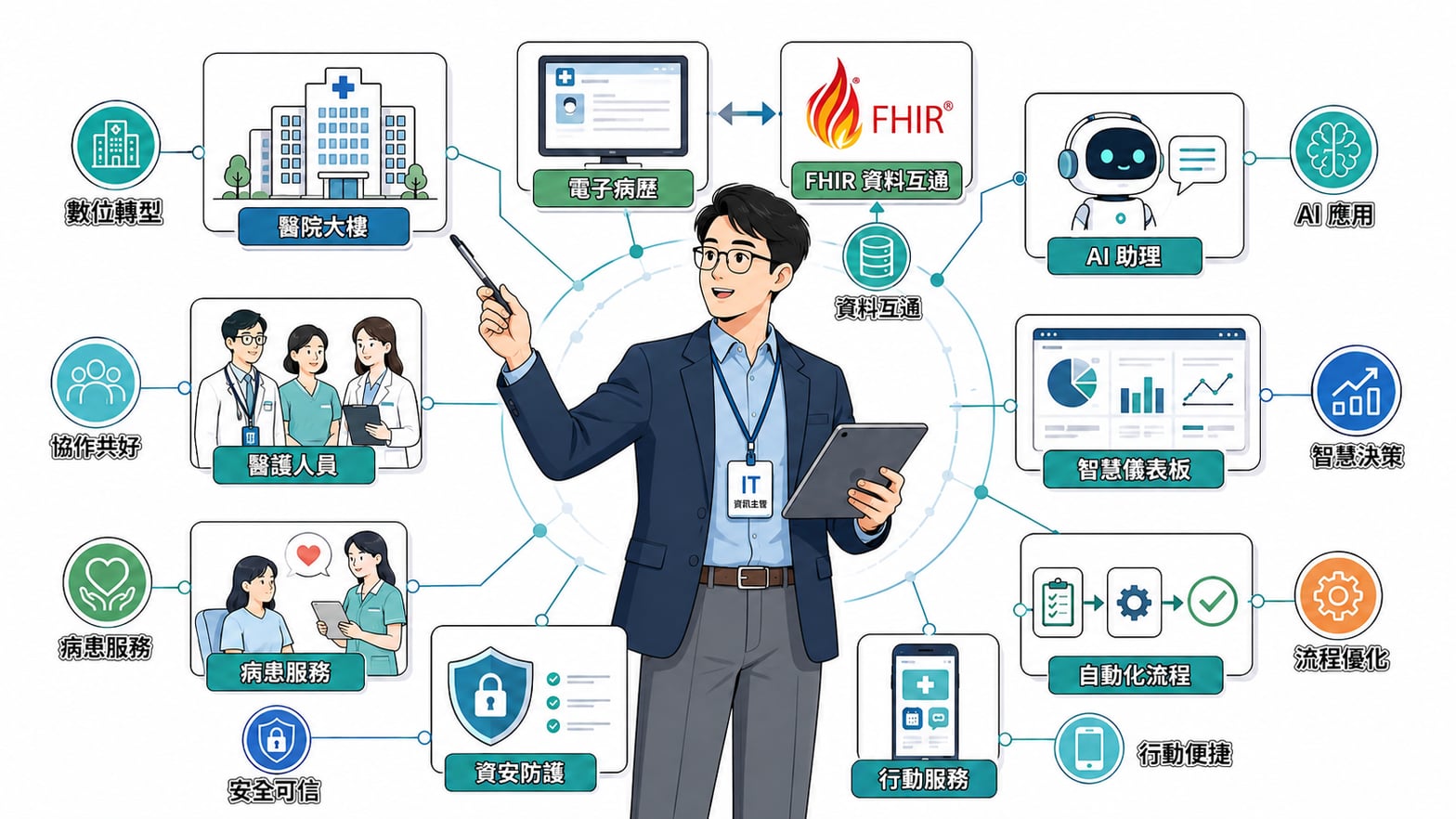
I half-jokingly call myself the hospital's digital-transformation evangelist. Preaching here is not shouting slogans on a stage. It is quietly getting electronic records, FHIR interoperability, security, and AI assistance right, one piece at a time, until clinicians and patients suddenly notice things got smoother.
I half-jokingly call myself the hospital's digital-transformation evangelist. The word evangelist sounds a little grand, but I do not mean the kind who stands on a stage shouting slogans over slides stuffed with buzzwords. Real preaching, to me, is quietly getting the system right one piece at a time, until everyone who touches it one day notices that things got smoother, without quite being able to say what changed.
The best system is the one you never feel
The foundations of a hospital information system, the electronic records, FHIR interoperability, the security layer, earn no applause no matter how well they are done. A physician will not come thank you because a data exchange between two systems went from manual copy-paste to automatic FHIR interoperability, and a nurse will not write you a card because login got three seconds shorter. But that is exactly the part I care about. When the system is good, the user feels nothing; only when it breaks does anyone remember that the IT department exists.
I spend most of my energy where no one can see it. Whether data can flow across systems, whether records can be read and written in a standardized way, whether you can trace back who changed what and when if something goes wrong. None of this has a flashy screen, yet it is the ground that every later AI application, smart dashboard, and mobile service has to stand on. If the foundation is off by a centimeter, the ten floors above it are all off.
Preaching is one small win at a time
I do not believe in the single, all-at-once grand reform. In a hospital, shouting "full digital transformation" usually only buys you resistance, because everyone's plate is already full. Ask them to spend extra effort on a new system with no visible benefit, and why would they.
So I preach through small wins instead. I pick a spot that genuinely hurts and can show results fast, automate away some action that gets repeated dozens of times a day, or turn a report that used to take three open systems to assemble into a single dashboard you read at a glance. The first time a unit experiences "oh, it can work like this," they become the next seed that spreads the word. Trust builds up this way, grain by grain, not by memo.
Collaboration works the same way. I have never thought the IT department should hide in the back waiting for tickets. I walk over to the clinicians and the administrative staff, watch how they actually work, and see where they get stuck. Many of the best improvements are not dreamed up in a meeting room; they are spotted standing behind the counter.
Human-centered is the whole point
Everything I do has to come back to people in the end. Physicians, nurses, administrative colleagues, and patients. A system exists to lighten their load, not add to it. If a feature makes a clinician click twice more, then however elegant it is technically, I send it back and rethink it.
Patient services follow the same logic. Letting a patient safely check their own records, receive reminders, and finish what they need to inside the tool they already use, that mobile convenience is held up by a whole rigorous design of security and authorization behind it. Convenience and safety were never opposites; you only call it done when you achieve both together.
I see AI the same way. It should not be a toy bolted onto the outside of the system, but something that grows right inside the workflow, saving clinicians a little paperwork and giving decisions a little more grounding. But the human always stays in the loop. AI offers suggestions, the human decides, and in medicine, that is a line I will not move.
The evangelist plays the long game
I believe in open standards, modularity, and open source first. Medical IT has been held hostage by closed systems for too long, and open standards like FHIR, REST, and event-driven design, together with open-source tools like Rails, PostgreSQL, and Kafka, let even a small team hold up a large platform. A system you can swap out like Lego, one brick at a time, so no single vendor can lock you in, that is what a smart hospital should look like in my mind.
This road is slow, and often without applause. But what I think about is what this system will have grown into in five or ten years, not whether this month's slides look good. That is just the nature of an evangelist's work. You will not see all of it finished in your own lifetime, but you trust that as long as you quietly set one brick in the right place every day, the building will rise in the end. And it will rise a little better than it did yesterday.