How to Replace an Old HIS: One Block at a Time, Not All at Once on a Chosen Day
Moving an old HIS one block at a time is not a new idea, it was just too expensive, so hospitals picked the big rewrite. AI cuts one block down to a few days, and the numbers change.
Two ways to do it
Every hospital information system reaches the same point after enough years. It cannot carry the load any more, so it has to be replaced.
There are usually only two ways to do that.
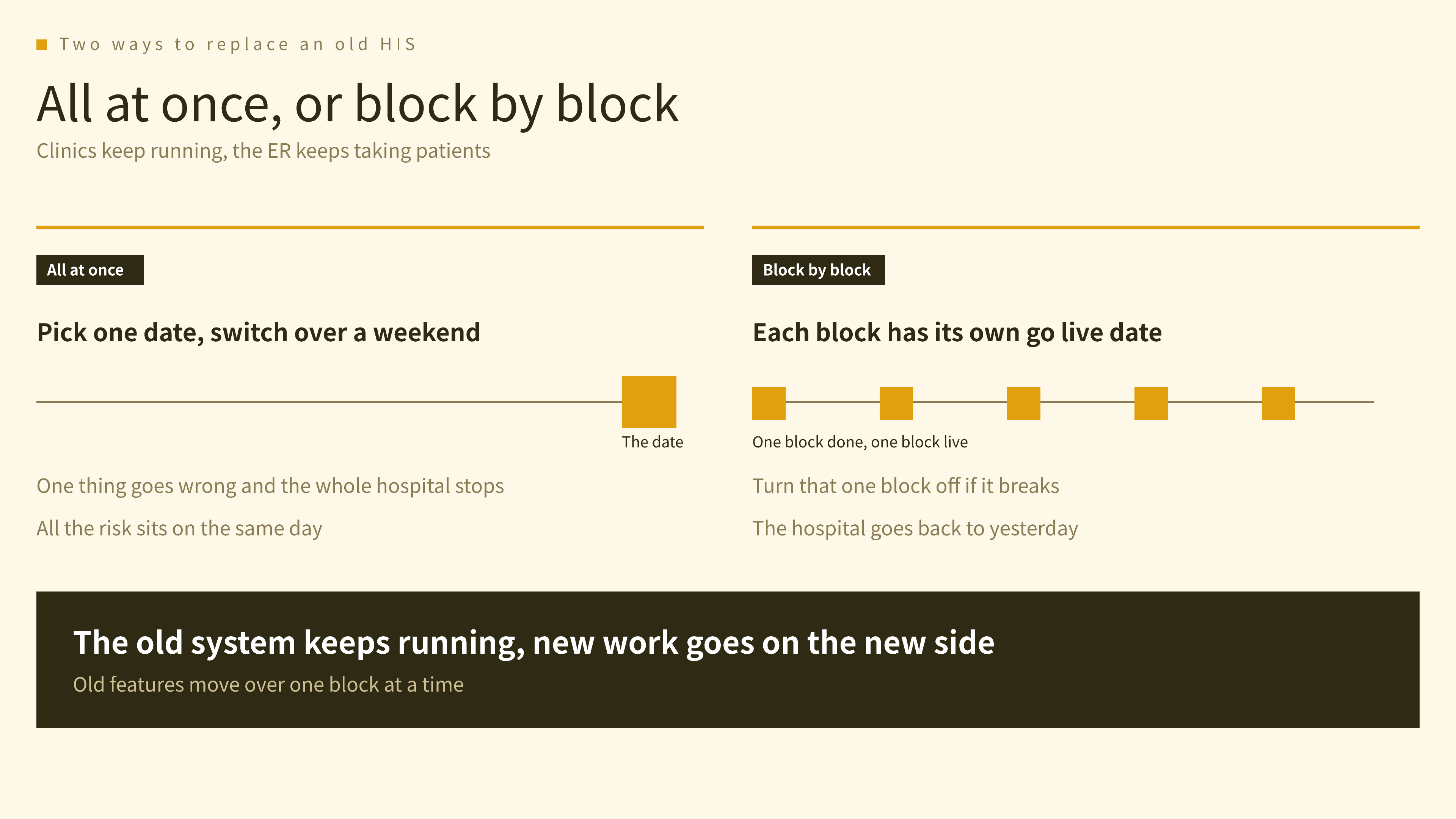
One way is to replace everything. You choose a new system, set a go live date, move the data over, and switch during a weekend. It looks good in a slide deck, because it has a clear end point.
The other way is one block at a time. The old system keeps running, new features are written on the new side, old features move over one by one, and each one goes live as soon as it is ready. When I say a block, I think of a building block. It is a complete thing on its own, you can take it out, and you can put it back.
This approach has a name, the strangler fig. It is the plant that grows on the outside of an old tree and ends up wrapping the whole tree.
I have always believed in the second way.
Why I will not pick one day and switch everything
A hospital cannot stop. Clinics keep running, the ER keeps taking patients, and inpatients are still in their beds.
Replacing everything at once puts all the risk on the same day. If one thing does not line up that day, the whole hospital stops together.
One block at a time does not have that problem. Every block has its own go live date. If something breaks, you turn that block off and the hospital is back to the way it was yesterday.
What moves is the data, the business logic stays
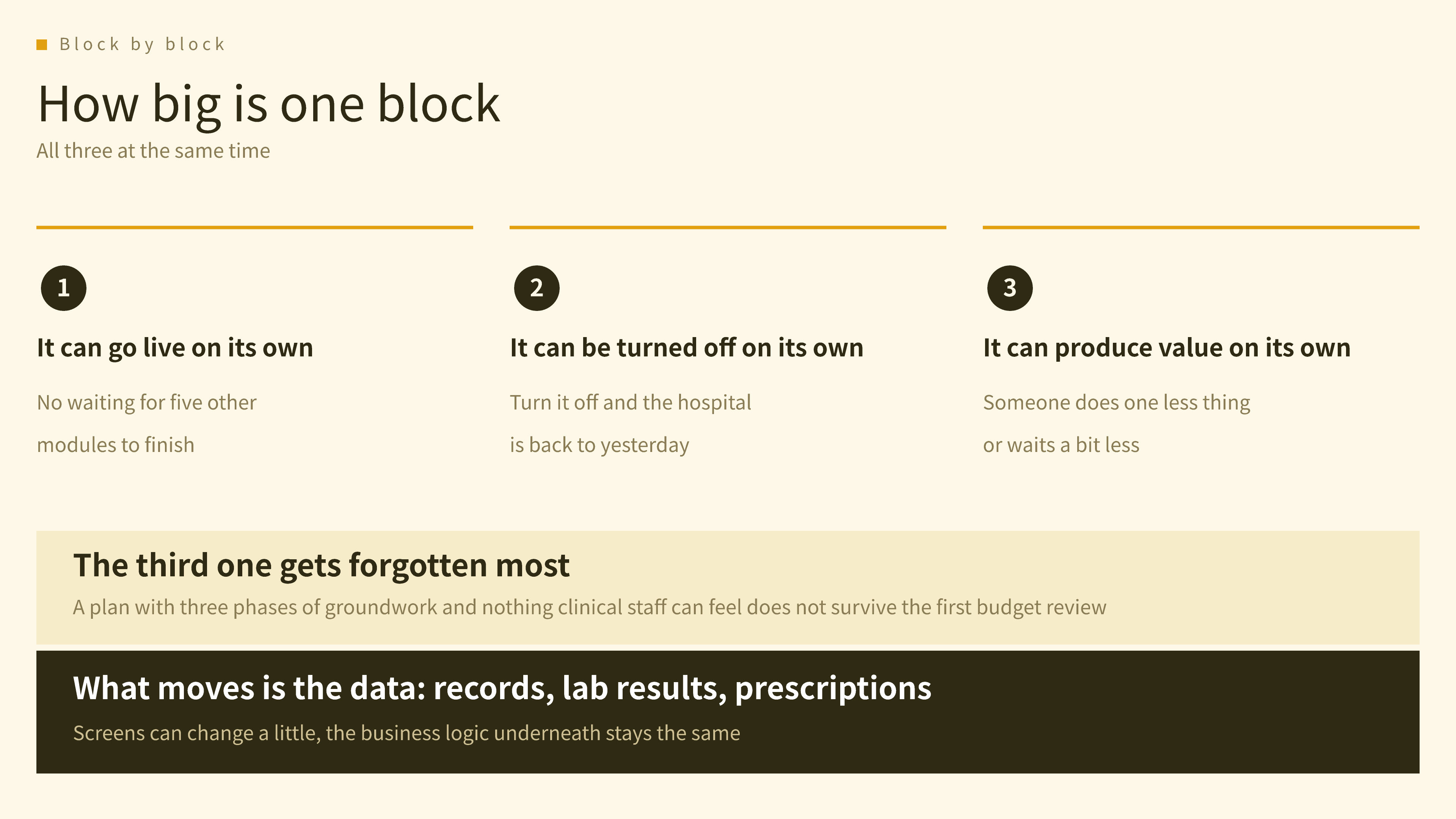
The thing that moves slowly is the data. Records, lab results, prescriptions. Who writes them and who decides what is correct, that is what moves, and it has to move clearly.
Screens are not frozen, but they can only change a little. Moving a button, putting the fields in a better order, filling in a default value, those are fine, and they are often small annoyances you can fix while you are moving the block anyway.
What cannot change is the business logic underneath. How a prescription is written, which fields are required, which step has to finish before the next one starts. Those have to stay the same as the old system. If a screen changes a little, clinical staff look at it once and know what to do. If a rule changes and nobody tells them, you get wrong orders, missing fields, and a workflow that stops.
Before I change anything, I ask one question. Who has to learn this again? If the answer is two hundred clinical staff, the design is wrong and I go back and do it again.
So running old and new in parallel is more than having two systems switched on. The more accurate description is that one piece of data has a new owner underneath, while the rules for clinical work are the same as yesterday.
How big is one block
One block at a time sounds vague, so I give a block three conditions, and all three have to hold at the same time.
- It can go live on its own. No waiting for five other modules to finish.
- It can be turned off on its own. Turn it off, and the hospital is back to yesterday with nothing left behind.
- It can produce value on its own. Someone does one less thing, waits a bit less, or makes one less phone call because of this block.
The third one gets forgotten most often. A lot of migration plans spend their first three phases on groundwork that clinical staff cannot feel at all, so they do not survive the first budget review, or they disappear when the manager changes. The plan is finished on the technical side and still dead in practice.
Why nobody did it this way before
The strangler fig is not new, and neither is the MVP. Hospital IT has known about this route for a long time. It just could not move.
Taking one block out of an old system means doing all of this.
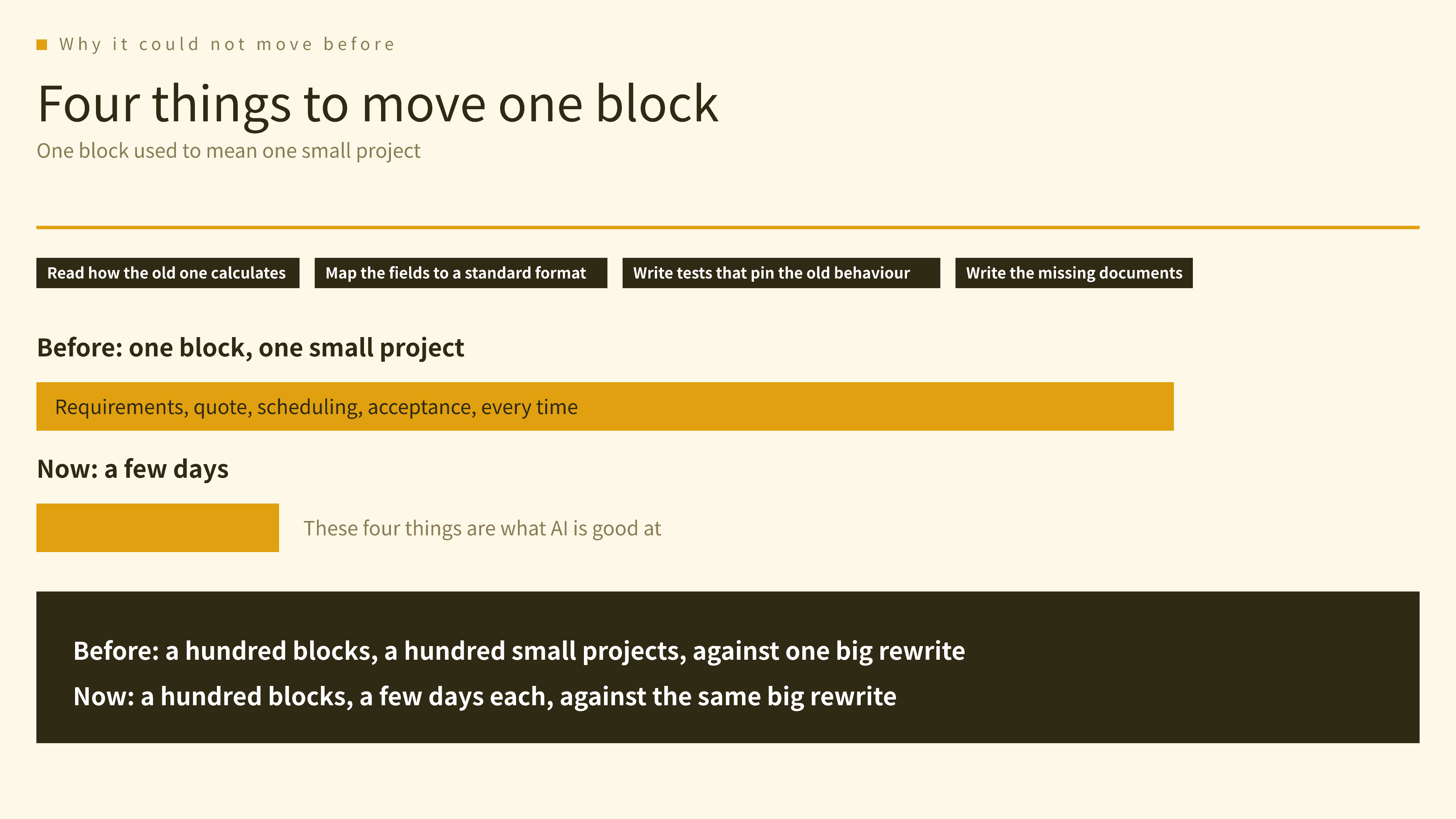
First you read the old code and work out how that block actually calculates. There is usually no documentation and the person who wrote it has left. Then you write a translation layer that maps the old fields to a standard format. Then you write a set of tests that pin the old behaviour exactly as it is. Even if the old calculation is wrong, you reproduce it first, and only then can you talk about changing it. Then you write the documentation that never existed, and add access control and security.
You do all of that to replace one block. There are ninety nine more behind it.
Doing it yourself, you never finish. Outsourcing it, one block means a full round of requirements, quote, scheduling and acceptance, and the vendor wants to sell one big project, not a hundred small slices.
Put both numbers together and the big rewrite comes out cheaper, so most hospitals end up choosing it. Everyone knows that moving one block at a time is safer. At the old cost it just did not add up.
How many days one block takes now
AI did not invent a new way to move a block. It made moving one block faster.
The four things above happen to be the kind of work AI does well. Mapping field to field, writing tests from the behaviour the old system already has, writing documentation from the code. This work is repetitive, there is a lot of it, and you find out in one run whether it is right or wrong. It used to take a small project to finish. Now you have something to look at in a few days, and you do not have to find a slot in somebody else's schedule.
So the numbers have to be worked out again. Before: a hundred blocks, each one a small project, and the total comes out higher than a big rewrite. Now: a hundred blocks, a few days each, and the total comes out lower than a big rewrite.
The part that got cheaper is only the building. Deciding what to build and what it should look like still takes a person, and it takes more time than before, because one day now produces as much code as a month used to, while the cost of getting a medical system wrong has not gone down. The way I handle it is to decide how much to let go based on the consequences. For screens that people only look at, I let the agent write them. For anything that writes back to the record or touches medication, the spec has to be clear and someone has to read the output line by line. That is what the criticality spectrum page is about.
What you need before you can take this route
A lot of people saw this direction a long time ago. The thing that blocked it was always cost.
You need at least two things. One is a standard interface, so new features have somewhere to connect and do not have to poke at the old database every time. For that layer the realistic choice today is FHIR. The other is a way of building that can take one block from nothing to production, because otherwise the cost per block stays high and you are back to the numbers that did not add up.
There is one more thing I keep reminding myself about. A block has to fit together with other people's blocks. When it is done, it has to be possible to hand it over to the next person, move it somewhere else, and put it next to what an outside vendor builds. A system that only the original author can maintain is no better for a hospital than being locked in to a vendor.
Related pages:
舊 HIS 要怎麼換:一塊一塊換,不是挑一天黃道吉日全部換
🔒 A Workable Proposal for Migrating a 20-Year-Old HIS to SMART on FHIR, One Strangler Fig at a Time
Taiwan's HIS Vendor Lock-In, and Why the Way Out Is SMART on FHIR
🔒 把老 HIS 拆成 Rails Engine 加 SMART App 的架構計劃書
Vibe Coding 的臨界性光譜:什麼時候可以放手,什麼時候得有人把關
一個人也能打造的智慧醫院:Omakase Smart Hospital
Pages marked 🔒 are not public yet. Only I can see them when logged in, the links are not broken.